Wednesday, May 19, 2010

THE SUMMER MY PARENTS RUINED MY LIFE…AND HOW ONE LIBRARIAN, A MAYOR, BERNIE’S & HAAGEN DAZS SAVED IT


On June 11th, 1980, at approximately 10:00 p.m. (with the voices of Channel 11’s Action News Team, Bill Jorgensen and Pat Harper, chatting in the background) just one day into my summer vacation from Paramus Catholic Girls Regional High School, my parents grounded me for the summer. The Whole Entire Summer!    
            In retrospect, leading your friends past your house while one of them (Wally W., are you reading this?) is swinging a six-pack of Michelob Light in each hand and E.L.O.’s Greatest Hits is blasting from Sue’s boom box was probably a really boneheaded thing to do. I tried to convince my parents that I was only months away from the legal drinking age—albeit, 36 months, but still, come on! I even fessed up that the primary reason attendance was high for Holy Trinity’s evening Teen mass was because wine was offered with communion, turning mass into an under-aged Holy Happy Hour. We stood, chaperone-less, encircling Father Donald on the altar as the golden chalice of wine was passed hand-to-eager-hand and liberally refilled by the altar boys because Father Donald could never quite remember where the circle began or ended.
           I was confident that I could successfully grieve my situation to my union president father. After all, he was a fair man who had a great deal of respect for, and knowledge of, the process of law. However, in my case, the legal process was suspended and all petitions for writs of Habeas Corpus were denied—my parents were in full “possession of the body.” Yet, there was a stipulation to the ruling; I was eligible for work-release and, when not working, I had full library privileges.
          By the next day I had secured three jobs, and settled myself into the Fort Lee Library. I never thought of not following my parent’s rules. Remember, there was no DYFUS back then; fear had a lot of mileage because every threat had follow-through attached to it.
I walked through the double doors of the library and meandered down the ordered rows as the sound of the boys from Madonna pitching coins against the wall outside floated in through the windows. I occasionally paused to inhale the musty mélange of glue, leather and the indelible scent of the passage of time. All was quiet and peaceful until my senses were abruptly disturbed by the compositioned floral powders of Chanel No. 5. Walking towards me was the blond coutured Reference Librarian. She pointedly inquired what I was looking for.
“My old life,” I replied. I explained that I was going to spend my summer honing my writing skills at the library because I was going to be a great writer.
          She let her designer bifocals slip down the bridge of her nose and replied, “If you want to be a great writer you must first be a great reader. Follow me. Take notes.” She handed me her pad of yellow-lined paper and a pencil and guided me on a literary tour of every aisle in the library.
“If you want to learn point-of-view read Henry James; if you want to learn irony read Jane Austen; if you want to learn what Hell smells like read John Milton; if you want to understand the importance of using punctuation read Virginia Woolf—she wouldn’t know a period if it got up and introduced itself to her; if you want to live among the wealthy in old Manhattan read Edith Wharton; if you want to learn how timeless are the problems we mortals face read Shakespeare; if you want adventure read The Odyssey; if you want to write history, read history.  The New York Times Book Review will make you a master of all subjects; The New Yorker and The Atlantic Monthly will introduce you to the best living writers; and mastering the Sunday New York Times crossword puzzle will give you a near perfect SAT score.  
“What if I want to learn about sex?” I queried in an effort to crack her composition.
“How about starting with Moby Dick?” she offered without effect.
“Call me Ishmael,” I replied. And with that, my sentence began.


Part Two: My Three Jobs (Spoiler Alert:  I’m still grounded.)

Wednesday, May 12, 2010

WAXING POETIC-NOT!


"A bottle of wine contains more philosophy than all the books in the world." - Louis Pasteur

“I think I’m gonna be sick.” –Ann Piccirillo

I was invited by my friend Kathy to dine with Lettie Teague, the former Executive Wine Editor of Food & Wine Magazine; presently the wine guru at the Wall Street Journal. I was thrilled! Not only would I meet an award-winning writer, but I would be dining with people over three-feet tall who wouldn’t ask me to cut their meat. How refreshing to sup with people willing to guide me to drink, rather than drive me to drink.
My love affair with wine began with a bottle of Boones Farm Strawberry Hill wine, and a boy named Michael who cut himself on the twist-off cap. I wondered if that story would amuse Lettie; or perhaps she’d be amused to learn that in my family it’s just not a party without a good box of wine on the table. With her pedigreed palate, her love affair with wine is akin to diamond-gifted trysts with a fabulously wealthy man at The Pierre Hotel; my love affair with wine is akin to waking up in a cardboard box next to a wino, whom I possibly dated in high school.
          I forced myself to push aside these oenophile musings to think about more immediate concerns—like looking my best. In this disastrous economy I’ve expertly learned how to cut corners.  I’ve gone from Lancôme to Avon, and, truth be told, my skin has never looked better. Anyway, while in the middle of ordering face cream the other night a screen popped-up screaming, “SKIN SO SOFT FRESH & SMOOTH HAIR REMOVAL MICROWAVE WAX KIT --A BARE NECESSITY!”  I decided to check the customer reviews; they were all five stars. It was on-sale for $10.99; what could I possibly lose except unwanted hair?  
          The box of wax arrived just in time for my dinner with Kathy and Lettie. I mean literally, just in time; it was delivered at 4:30 p.m., and dinner was at 7 p.m. I excitedly tore open the box and got to work. What happened next is best expressed by haiku:
“Wax goes on like fire.
Upper lip is siz-zle-ing.
Eau de burning flesh!”
          I positioned the linen strips atop the wax and ripped it off my upper lip. Screaming in pain, I looked to see if my lip was attached to the strip. However, when I looked into the mirror, NOTHING HAD COME OFF! Not even the wax. I scrubbed my lip with a washcloth, but all that did was turn my second-degree burn into a third-degree burn. Then I remembered I forgot to pull the strips off my eyebrows. Guess what? The wax worked on the eyebrows. The wax not only removed the unwanted eyebrow hair, but it took half of my left eyebrow off while leaving a thick residue of wax behind.
Frantically, I took a cotton ball dipped in oil and began to rub my lip and eyebrows. Disaster! The cotton was sticking to the wax leaving behind festive garlands of stringy white fuzz. I looked like an ancient Hasidic Rastafarian Rabbi. I continued to rub, and rub until I managed to remove most of the cotton fuzz, but there was no way to get rid of the thick mucus mustache I was sporting over my lip and above my eyes.
          Oh, no! Kathy was beeping outside. Quickly, I grabbed scissors from the cabinet and cut my hair to create bangs to camouflage my missing eyebrow. After the first cut I realized I had grabbed toe-nail scissors. I now sported bangs in the shape of Barney Rubble’s big-toe. To draw attention away from the flaws I applied lipstick, but the tube slid across my cheek and did a perfect figure-eight right into my ear. I looked like a Madame Tussaud’s Wax museum reject.  
          I’m happy to say that dinner was amazing, and the wine that Lettie chose for us to drink was spectacular. She even wrote about our dinner for the Wall Street Journal. However, she kindly left out my wax-encrusted upper lip and absent half-eyebrow. I don’t think the Wall Street Journal is ready to wax my kind of poetic…yet.


Wednesday, May 5, 2010

IN MY DAUGHTER'S EYES

I wrote this on Mother’s Day, 2006.  

“Getting my daughter to love me is the hardest job interview I’ve ever been on. I think I possess the right qualifications, but I’m years away from knowing if I got the job. You see, I wasn’t graced with a daughter who came into this world armed with unconditional love for the woman who gave birth to her, fed her, cleaned her, changed her, and rocked her. At 16-months old my daughter was diagnosed with autism and, for her, love is a learned task.
There is a great deal of heartbreak in this; imagine having to teach a child to love you. However, there is also an incredible lesson to be learned. How do you teach someone how to give love? How to receive love? How do you even teach a child what love is? Does love reveal itself in the tone of your voice? Is it embodied in physical representations? My daughter rebuffs most physical contact so to lather her with hugs and kisses can prove to be rather traumatic. Can she feel my love in those moments when I remit to her silent, yet willful resistance to everything? Or does it linger in the steady repetition of structured days and nights? And while most parents struggle with trying to keep their children well behaved, I struggle to teach my daughter basic behavior. For those of you who have ever been a part of the world of Applied Behavioral Analysis (ABA) you’re all too familiar with the mantras, “This is sitting,” “This is walking,” and “This is standing.”  Nothing comes naturally except frustration.
          I used to lay awake nights wondering why this has happened to our family. Now I have ceased asking “why,” and have surrendered to the fear. The fear of where the future will find my child. The fear of thinking, “Who can give her the care and attention that I do if something should happen to me?” The pulsating panic I feel when I realize that my life, my future, is as uncertain and unplanned as hers.
In moments of strength I gain great comfort in the realization that this journey that I’m on is preordained, and that the lessons derived from it will not only make me a better human being, but will take me to a place that I know I would never have arrived at if this awful pervasive disease had not come into my home. In moments of weakness I fall to my knees and weep.
          Currently there is a popular song that plays repeatedly on the radio called In My Daughter’s Eyes. I sob every time I hear it because reflected in my daughter’s eyes is a deep emptiness that mirrors exactly how I feel. Until last week when for the first time our eyes connected. For the very first time she looked at me with purpose and intent. My heart soared with unimaginable joy. In that moment her eyes revealed to me that there is a lifetime of knowledge hidden behind the perceived emptiness. Her eyes emitted the promise that over the long course of days she will reveal to me who I really am; who I am meant to be. But the lesson takes time, and in the interim I must let her teach me how to believe in hope.”   

          Kathleen has journeyed so far over the course of the last four years; she now has the language to tell me daily that she loves me. I am blessed.
          To my darling daughter, Kathleen; thank you for giving me the strength I never knew I had, and for bringing me to a place in my life I would never have had the courage to arrive at were it not for you.
Please take a moment this Mother’s Day to say a prayer for those mothers who untiringly journey beside me day after day after day who will wake up to no hugs, no kisses, no homemade cards or breakfasts in bed; mothers who will spend yet another day in a hospital room; yet another day administering therapy; yet another day laying flowers upon the grave of their child; yet another day soldiering on through their grief, never letting the world see them cry. 

Wednesday, April 28, 2010

AFFORDABLE SUMMER FUN


As we venture forth from our sweatered nests, it’s that time of year to catch up with the playground buzz. There’s a lot being talked about around the swings, but since this is a family newspaper, I’ll stick to a family topic. (Although, there’s some smoking gossip out there that screams “Mom’s Night Out!”)
Okay, back to my column. We all know that it’s really expensive to entertain kids; never more so than in today’s economy. Even a movie has become a major event now that most studios are releasing every kid-friendly flick in 3-D. Taking the family to a movie can cost close to $100, especially if you include snacks. However, here’s my biggest beef: 3-D admission includes a free pair of “Roy Orbinson glasses,” but then they have the nerve to ask theatergoers to “recycle” them into the big blue bucket upon exiting the theater so they can repackage them in time for the next showing. “Yeah, for ten bucks I’ll give them back!” (The 3-D’s to a 3-D movie are: debt, debt, debt!) 
Many people I know actually have a “family entertainment budget.” Thinking back to my childhood, my family’s entertainment budget was: “zero.” Our weekend entertainment consisted of the following choices: either help my father scrape the old paint off the house on Saturday and help him re-shingle the roof on Sunday; or, weed and rake the yard. Occasionally, my old man would throw in an oil change, or a “let’s take the motor apart to see why the ‘check engine light’ is on,” but the general theme of our family entertainment was “maintenance.” A real rare thrill was when we were thrown into the trunk of the Falcon station wagon to take a road trip to Aunt Peggy’s in Pearl River, New York. My brother and I had a ball bouncing around the trunk like a couple of spastic bobbleheads up Kinderkermack Road making faces at the bus drivers who had the misfortune of driving behind our car all the way to the New York State Line.
But I digress. I’m sure you also have fond memories of family outings that cost nothing, or close to it. Here are some ideas for a spring and summer of outings that won’t break the bank and will make for some great memories.
Minor League Baseball: We are so fortunate to be surrounded by some of the best minor league teams, so why not take advantage of it?
Staten Island Yankees: $16/ home plate; $14/reserve seats. Great all-inclusive packages available. SIY is a farm team of the NY Yankees. Stadium right near the Staten Island Ferry with a great view of Statue of Liberty. http://web.minorleaguebaseball.com/index.jsp?sid=t586
Jersey Jackals: NJ Jackals had 19 players sign with Major League organizations since 2006 season. $11/box; $9 reserved. http://www.jackals.com/home.asp
Newark Bears: The Newark Bears rank 3rd on Minor League Baseball’s top 100 Minor League Teams in history. $10/ticket; $1 discount for all military and first responders. http://www.newarkbears.com/
Brooklyn Cyclones: Farm team of the NY Mets; the stadium is right next to Coney Island Beach. Games frequently have fireworks displays. Tickets range from $8 to $16. http://brooklyncyclones.com/home/
Long Island Ducks: Part of the Atlantic League, they play in the Citibank Stadium in Central Islip. Tickets average $12. http://www.liducks.com/
Scranton Wilkes-Barre Yankees: This Yankees minor team is AAA, (the highest level of the minors) and a great place to see future Yankees players. It’s worth the 2 hour drive to Pennsylvania. Tickets are $10 to $14. http://web.minorleaguebaseball.com/index.jsp?sid=t531
Membership to New York’s Wildlife Conservation Society: a $124 membership fee ($78 tax deductible) for a family of four includes a year of free admission to these five attractions: Bronx Zoo, New York Aquarium, Central Park, Prospect Park, and Queens Zoos. It also includes four free parking passes, discount cards for gift shops and restaurants, and more.   http://www.bronxzoo.org/become-a-member/family.aspx
To find more affordable fun, and have access to the “Mom to Mom Calendar of Events” that lists just about every event going on in and around Bergen County (Street Fairs, Farmers’ Markets, Craft Fairs, Flea Markets, Outdoor Summer Movies and Concerts, Carnivals, and more!) become a fan of “BERGEN COUNTY MOM TO MOM” on FACEBOOK. It’s a page I created to connect you with everything that’s going on—for free! Check it out.

Wednesday, April 21, 2010

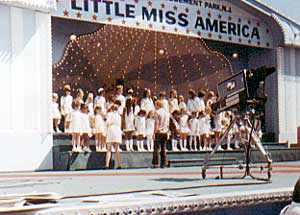
THE PARK CLOSES AT DUSK...

(Photo courtesy of PalisadesPark.com and the Cliffside Park Free Public Library)


Seems April skies are in her eyes,
A living doll that talks smiling as she walks.
May she stay somehow sweet as she is now. 
Little Miss America take a bow.

-Gladys Shelley

          I clenched it tightly in my hand. So giddy was I with delight that I hopscotched around the perimeter of the crooked columns of puddles that lined the concessioned Midway careful not to ruin my new white patent-leather Easter shoes. With practiced theatrical flair, I lifted the skirt of my yellow-eyelet dress to protect its netted hem from the splishy-splashy-splatters my heels were unintentionally kicking up. A girl had to dress just right for a momentous occasion such as this, you know. Clutched between the fingers of my “Tinker Bell” nail-polished hand was the application to the “Little Miss America Pageant.”
          I have such fond memories of Palisades Amusement Park—Casper’s Ghostland, the Caterpillar ride, the Archie Hot Rod ride, the French fries with vinegar, the games-of-chance, but there are two moments that stand out most. The first is Bozo the Clown bending down as I sat in my stroller, his soft white-gloved hand tickling my chin, and telling me with his zany laugh that he loved my red hair. I remember feeling faint as my idol patted my head like a dog. The second moment is hugging that “Little Miss America Pageant” application to my heart.
For years, I waited patiently to make the five-year-old age requirement so that I could showcase my talent to the world. I had no idea what that talent was. I couldn’t tap dance; I couldn’t sing; and my attempts at cartwheeling resulted in the toe-heel destruction of many porcelain knick-knacks my mother had precisely scattered around the living room.  However, I knew that in order to “win it” I had to “have it,” and I was trying really hard to “find it.” (Four decades later I’m still trying to “find it.”)
          Unfortunately, my father did not share my excitement about the “Little Miss America Pageant.” To put it mildly, he didn’t like the idea of his daughter prancing upon a stage before a crowd of strangers. It didn’t help that my life goal at that time was to be a “go-go dancer” and I routinely paraded around the house in a blue leotard and white knee-hi “go-go” boots dancing to “Chika-a-Boom (dontcha just love it!)” Hey, I was a product of my times. “Laugh-In” was in, man; Goldie Hawn made dancing in a bikini with body-graffiti and boots cool. And Dean Martin’s “Golddiggers” turned T.V. into a party! 
It’s funny how a child’s brain disregards historical timelines. Some of my earliest memories are fractured moments woven together into stories that, in many cases, neglect any accurate historical sequence. For instance, I have no memory of “The Park’s” closing. Nada. None. All I remember is that in April of 1971 I held the application to the “Little Miss America Pageant” in my hand, and the next memory is of the park burning. As ludicrous as it sounds now, I was convinced that my father had a hand in it so that I couldn’t compete in the pageant. The family did nothing to dispel this rumor; in fact, they encouraged it throughout the years with not-so-subtle jabs such as, “The Park would still be standing if only you didn’t want to be ‘Little Miss America;’” and then they’d laugh.
This I remember: The fire started just as school got out. My mother drove me, my brother, and our friends to watch it from the top of Route 5, at the curve where it begins its descent to Edgewater. I stood, one mourner among many, watching the flames lick to ash all that was once familiar and sacred. I remember the resounding hiss and crackle of those icons of pleasure echoing as they collapsed; indelibly burning themselves onto the pyre of our collective memory.
As dusk began to fall, the flames slowed their ascent until there was nothing left but the intermittent sparks of burning embers. Standing there, shivering as night began to fall upon the cliffs of the Palisades, The Park did indeed finally close at dusk, and this almost-Little Miss America watched it take its final bow. 

Wednesday, April 14, 2010

RE-BIRTH OF A JOY-ZEE GIRL


(Continued)  August 18th, 1980: “I can’t wait to be gone. Gone from this place; gone from this town where everyone knows everything about everyone. In this place nothing ever changes; people only die.”
I read the words of that teenage girl now from the distance of many years, and I can’t help but shudder. How could I have so thoughtlessly wished my life, and all that would ever hold any real meaning in it, away like that?
Teenagers are a funny species; they crave change while hating change. At the time I wrote those words change was happening to everyone but me. Old friendships were abandoned for new ones; friends moved away because their parents sold their houses to cash in on the real estate boom; being offered $150,000 for a triple lot seemed a once in a lifetime opportunity.  As ties began to unbind, I was beginning to feel lost at home. Finally, I was the only one still here. Leaving is always easy when you’re the last one to go.  
Eventually, I took a job in Manhattan and lost myself to the gritty intensity of midtown in the days before Mickey Mouse evicted O. Henry from Times Square. The city streets were filled with unfamiliar faces and people who knew nothing about me. Everyone came from somewhere else. And for awhile, that was intoxicating.
Then something remarkable happened. I realized that in my quest to flee everything familiar, I had surrendered all that was really meaningful. Suddenly I began to look upon my past with increasing fondness. The memories I had of growing up in that little part of town creviced themselves into a signifi­cant place in my history and became the stories I would tell.  It seems so important now—all the people and places that populated my small world back then. Sixth Street Park; Jim’s; Stanley’s candy in the back of the laundromat; Monsignor Reilly; Holy Trinity; the Palisades…all of it wished away by a young girl whose firm opinion of time was that it moved too slow.
Had I known in the summer of 1980 that my father would die in six years, I would have never left his side. Had I known that so many of the friends with whom I spent every waking moment with in the summer of 1980 would lose their lives to drugs, car accidents, cancer, murder…I would have never let the distance of time and place consign our friendships to the yearly distribution of Christmas greeting cards.   
There is a tremendous power in the past; meaning that we can only discov­er about ourselves through the passage of time and the loss of those we love, or once loved, most. It’s only when so much has been taken away that we realize how much we really had to begin with.
          I’ve returned to roam the streets I knew so well in an attempt to stir the trace remains of memory; not for the big events, but for those small subtle moments that now seem anything but ordinary. What I find instead are monstrous duplexes on tree-less streets where small shingled houses once stood; stillness where children once ran boisterously through fenceless backyards every hot summer evening while the music of ice cubes mingling in our parents gin and tonics chimed in the background; office buildings where hand-made forts and tree houses were once built.
Look­ing back to those days, those sacred days, as I so often do now, I confess that I carry within me home­sick­ness for those days, that place, all those people, and I remember events that may not, in fact, have happened as elo­quently as I now remember them. I realize with great regret that I spent the first half of my life counting down the days until I could shed my little corner of the earth from my skin only to spend the rest of my life trying to find my way back home again.
I'd like to think that some­where in the dis­tance between memory and truth those days were really as spe­cial as I remem­ber. That in the midst of memory all those people who came of age in that place called Coytesville, are still living and breathing some­where in time. 


Thursday, April 8, 2010

BIRTH OF A JOY-ZEE GIRL--PART ONE


I grew up on the Lower East Side.
          Of the Coytesville section of Fort Lee. Coytesville was like the gum on the bottom of Englewood Cliff’s shoe; the Hooterville to their Petticoat Junction. In its heyday, Coytesville’s saloons were like Korean nail salons—one on almost every sidewalk-less street corner. In 1965, I was brought home from Holy Name Hospital to a small house on a street with no name, just a number--5th Street. To my right was Interstate Park; to my left was the road that led to Jim’s Candy Emporium where my life-long love affair with everything confectionary began.
My father was a union man, and in the ‘70’s union jobs were like Wonka’s golden ticket—the decade before Reagen sounded their death knell; the decade before debt was handed out like lollipops at the bank. Everyone’s dad was a union man—police, fire, postal, teacher, iron worker, teamster, laborer; and everyone seemed to make ends meet. Like most moms, my mom stayed at home; like most families, we had two used American cars parked in our tarred driveway (yes, tarred; pavers were men who paved streets and not decorative driveway bricks); a house with no mortgage; and a week down the Jersey Shore every summer. All accomplished on one paycheck.
          The door­way to my world opened onto Sixth Street Park. If I close my eyes I can still see the sharp prism of sunlight reflecting off the jalousie glass windows of our aluminum porch door distorting the colors of the brightly painted merry-go-round into kaleidoscopic blobs of yel­lows, reds, blues and greens.
Within the perimeter of the playground sat the shallow hole of the blue-painted kiddie pool lifeguarded each summer of my childhood by Fritz, the ageless ancient German immigrant who lived next door to the playground. I’m not sure how to describe Fritz except to say that he always looked constipated. All summer long Fritz would bullet German-infused commands at us kids from the perch of his sagging nylon-woven lawn chair atop the small grassy knoll above the pool. When he ejected you from the pool, you asked no questions—you goose-stepped to the bench and served out your sentence in silence.
Sitting faithfully beside Fritz was his brown and black German Shepherd who made Cujo look like Morris the Cat. The same commands Fritz shouted at his dog, he shouted at us. When he yelled, I never knew whether to sit, growl, or attack one of the Carney boys. I swear he had to have been a former Scoutmaster in the Hitler Youth. Somewhere there’s a book in me screaming to get out, “Fritz’s Guide to Childcare—Sitz! Platz! Halt die Klappe!” (Sit, Stay, Shut Your Mouth!)
When I was around five, the Kempf’s rented the old Sweeny house across the street. The Kempf’s were the Walton’s without a conscience; at least the boys were. They shaved cats with straight edged razor blades; hoisted them up trees in rusting crab nets; fed spoonfuls of dirt to unsuspecting neighborhood kids; even pushed a Volkswagon Bug down a ditch. My old man swore the Kempf’s were moved in as a way to force us to sell, but eventually they were the ones who left. Oddly, with them went the neighborhood.
The wrecking ball knew no rest back then. Turn-of-the-century houses were replaced by quadrangular brick McMansions; familiar names moved out; new architecture and cultures moved in. By the end of the decade the old neighborhood was well on its way to becoming unrecognizable, and so was I.
Everything changed the summer I turned 15. I bore within me a restlessness that I never felt before, and would never feel again in quite the same urgent way. All that mattered were my friends; being confined at home for any significant amount of time gave me a mental rash. When I wasn’t working, I was sitting on the cliffs of the Palisades imagining the life I would someday live on the sky-lined side of the Hudson.
On August 18th, 1980, I wrote: “I can’t wait to be gone. Gone from this place; gone from this town where everyone knows everything about everyone. In this place nothing ever changes; people only die.”
To Be Continued…